


A Little Backstory First
I have been diagnosed with Meniere’s disease for twenty years, but that’s just the official beginning of an explanation for symptoms I’ve had for nearly all of my sixty years on this earth. Almost no one knows about this disease aside from other sufferers with vestibular dysfunction who either have nightmares about suffering vertigo on a regular basis, or the people who have a Meniere’s disease diagnosis already and have to deal with the vertigo and permanent hearing loss.
There are a few charlatans out there who pretend that Meniere’s isn’t that bad and they’ll sell you some over-priced snake oil that they swear will cure your Meniere’s for you. However, since Meniere’s is Idiopathic Endolymphatic Hydrops there is no cure.
There is no cure because there is no known cause. You can’t cure something without knowing what causes it. Meniere’s is no joke. (Is Meniere’s Really That Bad?) Vincent Van Gogh cut off his ear in an attempt to make the pressure, pain and tinnitus go away. To make the vertigo stop. He probably committed suicide because of it. I have been on disability for all of these last twenty years because of it.
If you want to know all the gory details of my forty year journey through this disease, this page:
Hits most of the high points (it is also linked on the sidebar) There are a lot of other links in that page including a link to my treatment article, which borders on needing a tl;dr explanation page itself.
Cochlear Implant Time?
My long-delayed trip to the otolaryngologist (The Saga of The Broken Foot) finally happened on July 8, 2024. I had been suffering vertigo and severe brain fog for months before that. The audiogram spelled out my future for me. My word recognition is down to 32% from 72% in my left ear. That’s it for me. I’m tapping out on preserving this ear any longer.
I talked it over with my doctor and we just went ahead and scheduled a cochlear implant (CI) evaluation meeting. Twenty years of non-stop tinnitus is long enough for me. If all I’m hearing through that ear is garbage now, I don’t see a reason to keep it plugged in anymore.
It is possible that the tinnitus won’t go away just by getting a CI. The labyrinthectomy that I’m going to have done at the same time won’t even get rid of the tinnitus beyond stopping the pulsatile tinnitus that wakes me up two or three times a night. Tinnitus is a lot like phantom limb syndrome, or will be after the surgery is complete. The ringing will probably still be there, it just won’t have a cause anymore.
The surgery that they do to implant the CI is called a Mastoidectomy. This was a thing I learned on surgery day when they listed it on my intake forms, and then later when I looked that surgery up trying to figure out why the bone behind my ear hurt. Oh. That’s why. (this is a correction to the original statement that I made here, that the CI went into the place where the labyrinth was. It can be placed there but isn’t always. –ed.)
The labyrinthectomy will eliminate the vertigo that stems from that ear, as well as the other noise that the cochlea is sending to the brain. That will all stop, freeing up all those FLOPS for other purposes. The scope of benefit that I could get from having this procedure done is hard for me to imagine. No more brain fog? Maybe. The Labyrinthectomy/CI should reduce that symptom. The tinnitus will alter even if it doesn’t completely go away.
Having one natural ear combined with a CI means that the natural ear will make the training process faster and easier (Your brain already knows what it’s hearing from the natural ear and will use that understanding to interpret the CI signals) but the retraining time for the vestibular system and the CI is still measured in months.
The benefits of a Labyrinthectomy/CI are real, but it is an invasive surgery. Permanent deafness on my left side will result, unless I wear the (Bluetooth enabled) magnetically attached receiver behind my left ear to make the CI work. Retraining the vestibular system once they place the CI will be required, and the CI itself has to be trained, a period that can easily run into months of time. Time is about all I have these days though, so that isn’t a huge barrier for me.
I asked around and did get some feedback from other sufferers who have cochlear implants. I wanted to understand this better before I made the decision. I want the bad ear to stop producing noise, vertigo and dizziness and it seems silly not to get the CI if I’m going to go under for the labyrinthectomy anyway. Most of the people I spoke to agreed with this assessment.
Cochlear Implant Evaluation
At the evaluation meeting I talked with the audiologist about how my loss of hearing affects my daily life. It took a little while for me to realize just how much of my life has been altered over the course of my forty years of experience dealing with the symptoms of Meniere’s. We don’t go anywhere or do anything, really. It’s so painful to be out in a group of people and not be able to communicate with them easily. The confusion that emerges when you can’t follow a conversation unless you are focused on the person talking to you. The hyperacusis that appears after a prolonged exposure to loud noises, which is also why the standard amplification of sound that hearing aids produce will not help me.
The degraded hearing has seriously impacted my quality of life. That’s what the evaluation proved to me. Asked to grade various statements on a scale, a huge swath of them were as negative as they could be.
They fitted me with a BiCROS device as a part of evaluating me for the CI. A BiCROS is programmed to compensate for lost hearing in the good ear, while at the same time incorporating sounds from the side of my head with the bad ear.
The thing I took away from this test was that It’s distracting being able to hear my keys jingling again. It had been so long since I had heard those high tones (forty years at least, probably) and it was nice being able to hear sounds on the left side of my head again.
However even with the BiCROS operating my hearing was bad enough that I did qualify for Medicare coverage to surgically place the CI. It now falls to my doctor and my insurance company to negotiate what the insurer will pay for and when might they pay for it. I will be checking back in a month from now for an update on costs and timeframe.
There are two companies producing CI’s that I need to choose from:
Both implants can be bimodally linked with a hearing aid on the good ear. I think I’m leaning more towards Cochlear but I don’t have a strong opinion yet. Training resources are here.
It’ll be November before my doctor is available to perform the surgery anyway (she’s out on maternity leave. The birth was successful) so I have a few months to think over the rather dramatic step that I decided to take. On the bright side, maybe I’ll be free of tinnitus for the first time in twenty years. That’s a glass half-full way of looking at it, I think.
Meeting With the Surgeon
It’s finally November! I went to see the new mother and surgeon at her office. She performs quite a few of these operations each year. I have very few qualms about her competency to do the job required. She will drill out the cochlea for the labyrinthectomy part of the procedure, and then thread the cochlear implant sensors through the round window between the middle and inner ear.
The round window is different than the oval window that most people who have browsed the subject of ear structure will probably know about. The three bones and muscles of the middle ear press on the oval window, and the fluid pressure is maintained in the inner ear through the movement of the round window.
With the labyrinth gone the oval window connects to nothing, basically. The round window is the entry point for the CI because it essentially leads straight into the part of the inner ear where the wave sounds of the cochlea are turned into nerve impulses.
It will be several weeks after the procedure before it will be safe to do the ear clearing and whatnot that I tend to do reflexively. I’ll probably have to keep reminding myself not to do that. Forty year habits are hard to break. (I did manage not to screw that up. –ed.)
The outer and middle portion of the ear should be essentially the same after the incisions heal. That was my only real qualm. What, aside from deafness in that ear, should I notice about the change? Nothing much, apparently.
Long, thick hair over the transceiver’s magnetic attachment point may be a problem for some people. I have so little hair left that I’m not too worried about that.
The afternoon of December 20th will be my surgery date. There will be a follow up a week after that, and then three more weeks before they can activate the device. I’m on pins and needles now.
I’m trying to enjoy my last month of normal hearing. Every song that has stereo effects in it calls out the fact that the left ear simply isn’t functioning anymore. Guitar parts are gone. Alternating voices are gone. Songs that slide back and forth across the stereo spectrum appear to decrease and increase in volume. It’s very distracting.
The Begging Block
Writing is work. A lot of work. Maintaining a blog takes a lot of time and energy. I don’t have ads on the blog because I fucking hate advertising and I never received anything worth mentioning from Google ads during the decade I let them place ads on my blog (ditto for the Amazon affiliate program, which is why those links are now slowly going away) This means that if I want to defray the costs of maintaining this blog, it has to come from my readers. If you are reading this and if you can afford to throw me a buck, I’m counting on you to click one of the links below and send me a few of them. The Wife, the children and I thank you. Especially the children, who have grown tired of cold gruel.
Surgery (December 20, 2024)
One surgery is much like another these days, from the perspective of the person being operated on. A dozen new faces you’ll never see again and won’t remember the names for if you do. The same old prep documentation going through history and drug use. The multiple confirmation questions about what part, exactly, they will be operating on today.
The wife and I did our usual Burns and Allen routine (she’s Burns without the cigar, I’m Allen) to entertain the bored nursing staff. It’s not like we’re performing, we’re just like this all the time. Old, married people are weird.
After we’d met everybody, my favorite person finally showed up. That’s the anesthesiologist who gives me the good drugs. After the administration of the drugs (which I can generally taste/smell even in my veins) they wheeled me down the hall, which is about the time the lights always go out for me. I am a cheap date. I rarely get to see the operating theater.
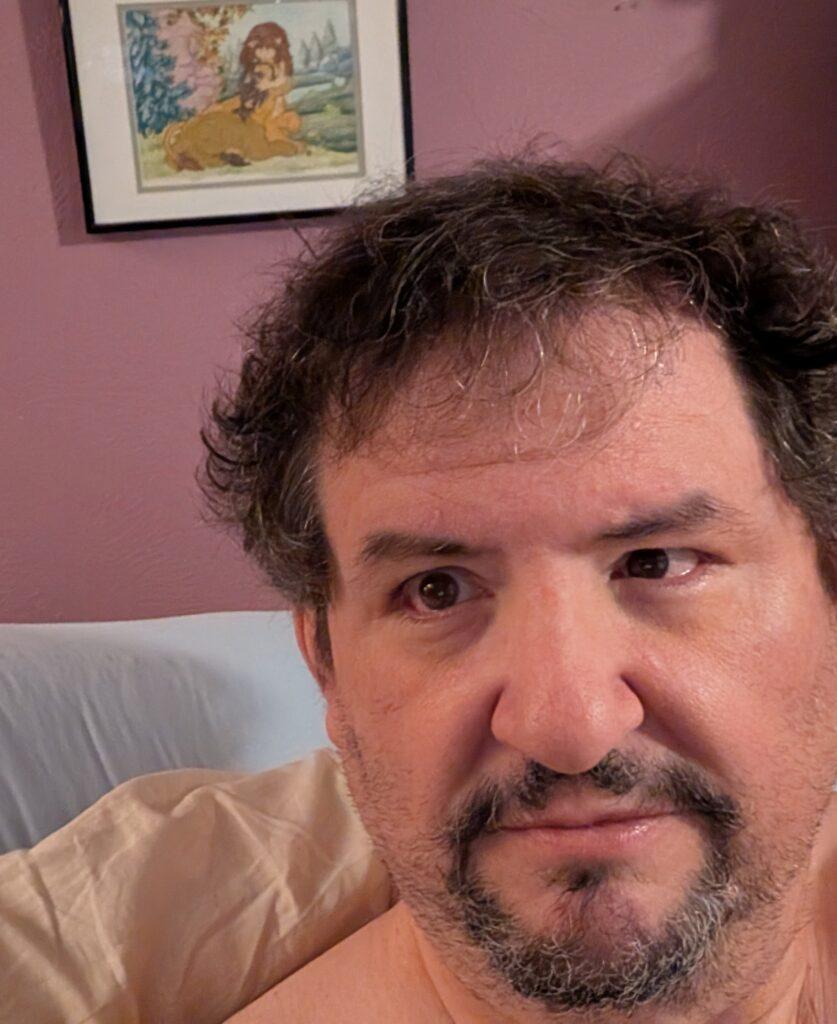
When I woke up about eight hours later I was in a little more pain than usual. This was heightened by the nystagmus and stigmatism that my eyes were exhibiting and the eye movement was so erratic that I was occasionally getting double vision from it.
It was at this point that I realized why some people close their eyes when they experience vertigo. I could never close my eyes before. The vortex was something I could feel more profoundly with the eyes closed, so keeping them open was how I kept the nausea at bay.
That just wasn’t working this time. Try as I might I could not focus on a point in order to make the spinning stop. However, there was no feeling of spinning when my eyes were closed. So I just left them closed. Sweet relief!
I was the next to last one out of the surgery center that night. The other guy was throwing up blood, so I’m guessing he was in worse shape than me. My vertigo was so bad that it would have been advisable to keep me there over night just to have IV delivery of anti-nausea and anti-vert drugs available until the vertigo passed.
It was an outpatient surgery though, and so I was bundled out to my car where I groaned like a dying man at every bump and turn in the road on the way home. Then came the rollator and the slow crawl into the house and to the bedroom where I spent the next week or so.
All in all the surgery and outpatient experience have been as advertised. I still have tinnitus that varies from a mild rumble (like an earth excavator coming through the walls. You know, mild) to the sound of a phaser on overload.
The vertigo eventually eased off to the point where it’s more of a disorientation that I have to pay careful attention to if I don’t want to injure myself on something, rather than an active spin that I need to try to counter.
The only other thing worth mentioning right now is this kind of typewriter noise in my left ear. It feels and sounds like old mechanical typewriter keys being struck and impacting the eardrum (which doesn’t make any noise anymore) the only thing that I can think it mighty be is middle ear myoclonus, the muscles and bones of the middle ear twitching against the now-dead oval window and eardrum.
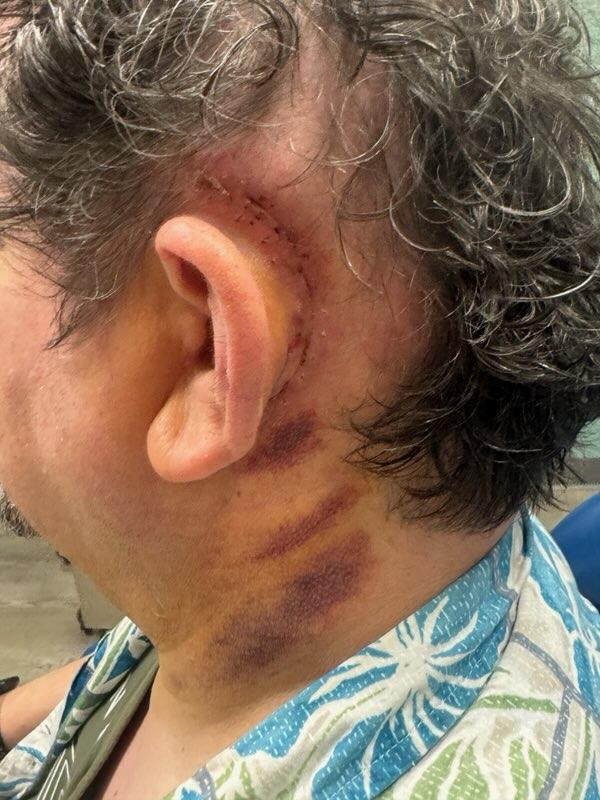
December 27, 2024 – The post-op visit to remove the stitches has come and gone now. So has my first few attempts to ramble the neighborhood in the way that I am used to doing each morning. Removing the stitches went flawlessly and everything is set for the activation of the implant on January 10th.
The rambling of the neighborhood hasn’t gone quite so well. As my doctor and my family constantly remind me, I have just recovered from major surgery that has seriously truncated my vestibular systems. There are bound to be long-term effects of this that I’m simply going to have to wait out. I don’t do waiting either easily or happily, though, so the next few months are going to be rough for everyone around me. I apologize in advance for the asshole that I’m sure I’m going to be during this time.
The eustachian tube on the surgery ear finally opened back up on December 31st. Nothing quite like the taste of bone dust and old blood in the back of the throat to put a damper on New Years Eve. It was a good excuse to go to bed early though, so I used it as an excuse to do exactly that.
I’m getting a lot of sinus drainage and eye weeping on the surgery side. Also, my vision seems to have changed. I’m definitely getting eye strain while wearing my old glasses. The increased stigmatism I noticed immediately following surgery seems to still be present. My doctor has reassured me that the weeping isn’t related to the surgery. I do wonder if I didn’t trigger it by blowing my nose too hard. It’s possible.
Correcting the eye strain ultimately may require a visit to my eye doctor for a new pair of glasses at some point in the not too distant future. Several people who have had the surgery before have corroborated their vision changing in this fashion after the surgery. I needed new glasses anyway.
I’m also noticing a weakness in the jaw and in swallowing. This is apparently a side effect of the intubation required for the surgery. I’ve been encouraged to work on getting the muscles to respond the way I remember them doing before.
A little bit of jaw pain and mastoid pain too. The mastoid pain is to be expected since they actually changed the shape of the mastoid on the left side of my head while putting the CI in. The jaw pain is also probably a reaction to the intubation. I’m apparently a whiney patient that doesn’t want to take their pain meds and drool in front of the TV set like most people. Go figure.
The dizziness does seem to finally be fading. If I get enough sleep at night (take your pain meds!) then the next day I do seem to feel much better. Getting the sleep is the important part. I need to remember that.
Cochlear Implant Activation (January 10, 2025)
There was a snafu with my health insurance that is still being worked out that almost kept me from going to my activation appointment on the 10th of January. I had resigned myself to this fact the day before, but a weird side effect of the surgery that I have gone through reset all these plans, which was a good thing.
I don’t know why but the labyrinthectomy has altered one of my faulty internal clocks. I know this is true because I know when the sun comes up now, or is about to come up, and I wake up right about that time pretty much every morning. As the Wife can attest, this is a thing that is almost unprecedented in my life. She has acted as my alarm clock for the entire time that we have been married. Alarm clocks can’t wake me. I simply sleep through them. She hears them and pokes me, and after about a half hour I will get out of bed.
Not anymore. Now the blinds on my eyes go up like a cartoon character (flippa-flippa-flippa) right about sunrise, and I’m awake whether I want to be or not. Sometimes (like the morning I wrote this) I can make myself go back to sleep after a few minutes of tending to bodily functions, but generally, waking up means it’s time to take drugs and start my day because I’m going to be awake until nap time, which is also a thing I do now.
Consequently I was awake when my audiologist’s office called early that morning to let me know that if I couldn’t make it in on the 10th then it would be at least three weeks until I could get in to see her, which was unacceptable. There won’t be money or a United States after the 20th of January (not to mention a healthcare system or doctors) in my zombie plan future, so it was important that this event occur before that deadline. I bit the bullet and paid out of pocket for what Medicare wouldn’t cover, and I kept my appointment so that I could discover the mysteries of an active cochlear implant before time ran out.
I’ve known this particular audiologist for a significant portion of my time with Meniere’s. She has been working with my ENT for many years and I’ve been seeing her for almost a decade now. She showed me the backpack full of stuff that came along with the tiny little device that was already in my head (including replacements for most of the items that are attached to the outside of the head, which is good. I have a bad habit of breaking things) then she attached the Nucleus 8 sound processor to my head (after determining that the swelling post-surgery was keeping the Kanso 2 processor from sticking to the side of my head. give it a week) It’s mildly amusing to me that there is a magnet in my skull now, but I have been banned from performing party tricks like sticking a spoon to the side of my head. I live with a bunch of party-poopers.
The magnet in my head is still very weird. It clicks around in there anytime another magnet is close to your head. When I put on my Shokz headphones, if I pass the speaker too close to the connection point, the connection will move around, sensing the magnet in the other device.
This makes getting the transmitter coil properly mounted on your head quite easy. Simply move the thing around on the side of your head until the two magnets start audibly trying to attach to each other; and then let the thing stick in that place that seems to want to hold it.
I’m getting quite good at getting the coil attached, even when it’s under my bandanna and I can’t see it. Just listen for the thing to move in my head, and then leave it there.
There were a series of tests where she set my levels for the various ranges of sound the device can pick up, then it was time to finally turn the thing on. It’s important to note here that when I went in for surgery I considered the CI a bonus. I really just wanted the labyrinthectomy and only asked about the CI because I knew that I needed to have both done at the same time if I wanted to have a CI at all. I have one relatively decent ear (or so I thought before activation) that I could still rely on, and binaural hearing was simply a thing I never thought I’d have again. I’ve known this was my future for twenty years now. I was reconciled to only having monaural hearing.
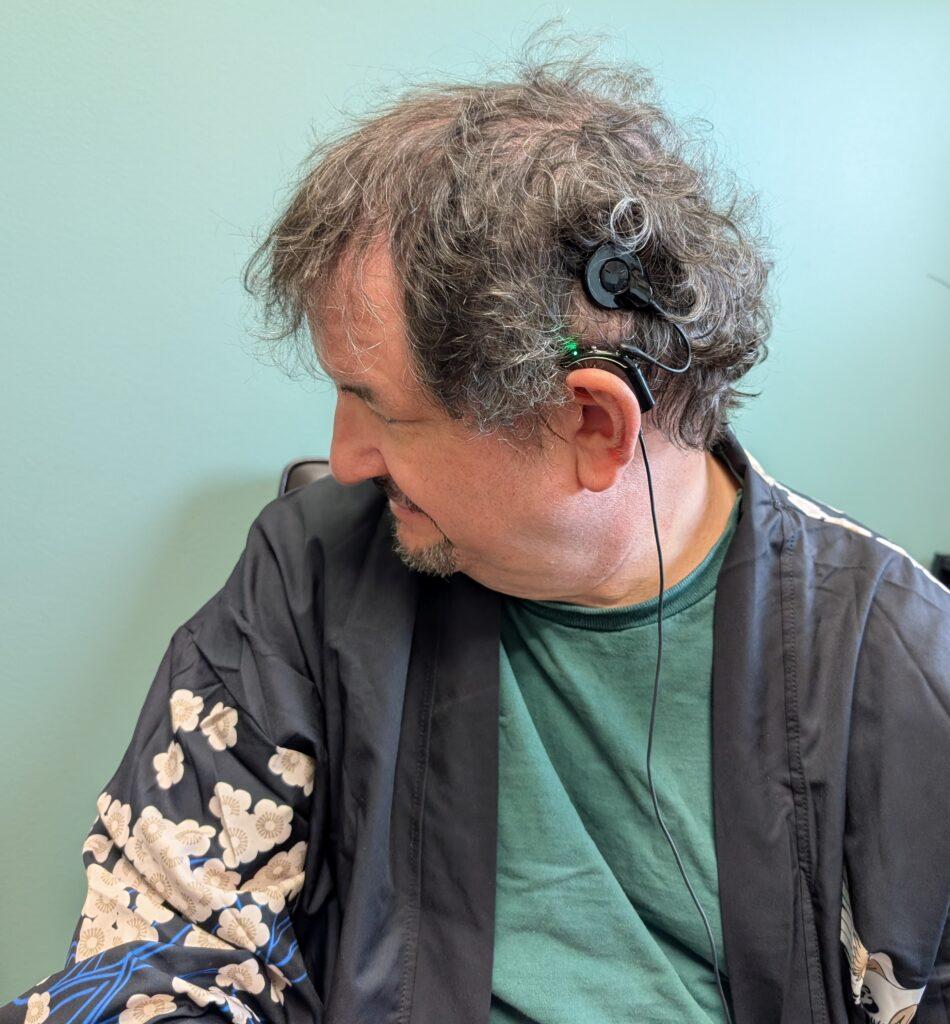
So when she turned the CI on I was not prepared at all for what it would be like to hear out of that side of my head again. As I had noticed while testing the BiCROS, there are a lot of high sounds that I don’t hear at all anymore. Suddenly, I could hear her mouse clicking. I had no idea what that noise was and had to ask. All kinds of noises that I couldn’t hear before, like fluids bubbling on the stove, I could now hear again. The tears wanted to flow at that point.
As I mentioned previously, the tinnitus that had been in the left ear for years has gotten really, really annoying since the surgery, so I was curious to learn if the tinnitus was going to improve or not after the implant was turned on. That, at least, would be a blessed relief.
As soon as the implant was activated, the tinnitus simply vanished. I was amazed. Tinnitus has been my constant companion since I was a teenager and damaged my hearing playing with fireworks. Since I stuck my head in a speaker at a rock concert without wearing any ear protection. (I was partially deaf for several days in both instances) and especially since the vertigo attacks started hitting me on a weekly basis back in 2000. I was never without it. The tinnitus was a lot like the partial numbness I feel in my hands since I got minor frostbite as a teenager. It was an announcement to the control center of my brain that that sense was still there, even though it was damaged.
The tinnitus did partially return after I removed the device, but it took several minutes. In those minutes I finally realized what it meant to be profoundly deaf. To not even have the illusion of hearing on the left side of my head. That ear is just there to hang things on now. it’s an ornamental feature. This is a fact that should have been driven home when I washed the ear after the staples were taken out and I couldn’t hear the washcloth passing over and around the ear. The tinnitus not being there made me nostalgic and a little sad for a bit. Then I realized I wouldn’t have to be driven crazy by it anymore and I nearly cried with joy, again.
One of many times that I was almost in tears over the course of that hour and a half. Like during the tests when the audiologist was checking my word recognition (80th percentile for first day. Nice to be good at something) talking to the Wife and my audiologist about the long history of our interactions and hearing their responses in the ear that I knew only worked now because of this tiny little device attached to the side of my head.
The audiologist also advised me that the difficulty that I was having in navigating stemmed from the nystagmus that has developed since the surgery and that the Vestibular Ocular Reflex (VOR) exercises I had been given years ago would do wonders for clearing that up.
So I’ve started doing those daily again. They are, in fact, helping with the disorientation I feel while walking. I’m still only doing about a half mile a day, but at least I don’t feel quite as queasy after I’m done walking.
The Begging Block
Writing is work. A lot of work. Maintaining a blog takes a lot of time and energy. I don’t have ads on the blog because I fucking hate advertising and I never received anything worth mentioning from Google ads during the decade I let them place ads on my blog (ditto for the Amazon affiliate program, which is why those links are now slowly going away) This means that if I want to defray the costs of maintaining this blog, it has to come from my readers. If you are reading this and if you can afford to throw me a buck, I’m counting on you to click one of the links below and send me a few of them. The Wife, the children and I thank you. Especially the children, who have grown tired of cold gruel.
First Implant Adjustment
My poor confused left ear neurons. They can’t figure out what’s going on anymore. I take the processor off the side of my head and the tinnitus goes all over the place. I have it on the side of my head and something like hyperacusis seems to be occurring.
Previous experience tells me that I have an ear infection because my hearing sounds like that when I’ve got an ear infection. Except, of course, there isn’t any relationship between the sound produced by the CI and the amount of swelling that might be present in the middle ear.
When I went to the follow-up appointment for CI adjustment, the audiologist (acting on the above description) looked in my left ear just to reassure me.
“There may be some fluid behind the eardrum, but that’s normal for post-implant surgery.” she said.
She remapped the CI to alleviate the sensation of hyperacusis that I was getting. It seems to be a little better than it was before. I’m just going to keep turning the thing down when I feel like I’m bordering on a migraine. She cautioned me to keep it on as much as possible, but I was already taking that stance anyway. If it’s safe to have the thing on, I’ve got it on and I’m listening to it. I’m even streaming my podcasts to it directly most days.
I’m still not supposed to force air up in the eustachian tubes (I won’t admit to doing a few times then, I guess) to relieve the imaginary pressure I’m feeling. Psychosomatic symptoms are the worst.
She also put me in the sound booth and tested out my word recognition while blocking sound reception in the natural ear. My progress is still in the 80th percentile. It’s nice to be better than average at something.
At twenty days since my turn on date, music is still largely unrecognizable to me outside of tunes that I’ve been screaming at the top of my lungs in the car since the 1980’s. It’s interesting how much more sound the CI picks up than the natural ear. Even with the insurance the hearing aid for the right ear that will sync up with the implant will be too expensive for me to afford, so the partial hearing that I have right now is likely to be all I will have for the foreseeable future.
So continues the months-long struggle to regain something of what I’ve lost over the last twenty years; and maybe, in the end, I might actually gain even more than that. I’m still struggling to regain my pre-surgery walking stamina. I walked a mile and a half today, so I’m getting closer to my old workout pace. When I can wander for 5 miles and still have to be dragged home by the dog, I’ll consider myself recovered.
March 18, 2025 – The big question for me remains, can I make my music sound right in this mechanical ear? I’m becoming more and more convinced that the hyperacusis that bothers me (and the blown speaker form of the sound that I hear through the implant) is the brain still assigning tinnitus to those frequencies. Tinnitus that may or may not still be a dysfunction in those particular nerve endings. Training continues.
Conclusion
I pinned this article to the top of the blog:
Before writing this conclusion. That article supersedes this one because, frankly, there is a whole new world out there for me now because of this surgery.
I haven’t had vertigo or a dizzy spell since recovering from the surgery. I’ve been tracking my dizziness since the surgery and I have barely noticed it at all (aside from basic clumsiness from only having half my vestibular system) For the last 3 months. If someone is having constant vertigo and they are certain the symptoms come from the labyrinth of the inner ear, a labyrinthectomy works as advertised.
As far as the cochlear implant goes, it’s worth noting that any hearing is better than no hearing. If your ear is producing noise, turning off the noise makes the hearing in the other ear better. That has been my experience. The left ear only produced noise and removing its ability to produce noise resulted in a net positive effect. The cochlear implant is still being trained. It will probably always be in the process of being trained. If that status alters at some future date, I will update this article with the new information.
As I type this, I can listen to voice podcasts without sound tracks and loud atmospheric effects without losing any word recognition. Introducing noise brings the word recognition down. Still, I’m over 90% word recognition, when before the surgery I was at 40% or less depending on the day.
Music is still hard to understand. 1960-90’s songs that I grew up listening to, I can recognize almost immediately. I can recognize some classical music that I listen to regularly. The sound quality is not the same as a natural ear produces (what is it like for newborns? That’s the question that bugs me) but it’s better than the left ear was at the end and definitely better than no hearing at all.
If I play music through speakers I can hear tones in the music (between the two ears) that I haven’t heard in 40 years. It still brings me to tears.
I think it’s too early to assess my opinion of the tech in my head, but the labyrinthectomy has done exactly what I wanted it to do. I have my life back, albeit in a clumsier fashion. I’ll take it.
Featured image: wikipedia.org/The_Fighting_Temeraire Yes, I changed it from the implant picture that wasn’t the implant in my head.

thanks
Interesting read! It’s always enlightening to hear personal experiences with Meniere’s, a condition that not many are familiar with.
Regarding your decision to opt for a cochlear implant, it sounds like a brave step forward. I’m curious if you’ve explored other non-surgical therapies or found any that temporarily alleviate symptoms before deciding on this path?
Hoping the upcoming procedure brings you much-needed relief and clarity. Thanks for sharing your journey!
I go through my forty year treatment adventure in this article: https://ranthonyings.com/2015/02/treating-menieres-its-symptoms/ I have now added a link in the article itself that goes to my story page and the treatment article. The story page is right there on the desktop, but on mobile interfaces it’s down at the bottom of the doomscroll so most people miss it. I link the treatment article so frequently online that I figured everyone who comes here has seen that article already. Clearly I was wrong. Again.
When I first got diagnosed by my otolaryngologist as being bilateral i was lost , then i found your blog . I have lived by one comment you made “ it’s not a death sentence “ this gave me hope . Amazing how we humans can adapt to adversity in life . Thank you for taking the time to detail your journey there’s so much misinformation on this topic .
Amazing, thanks for sharing RA.