

An old friend of mine recently submitted the opinion that there is no true SciFi except:
I would like to enter into the court Exhibit A: 2001, A Space Odyssey! Based on a book by Author C. Clarke and directed by the late and Great Stanley Kubrick.
Because 2001 contained only real science, and it’s the only film that has; so my whole problem with canon, and jumping the shark, was pointless because it was all a fantasy, not required to be internally consistent. Don’t take it seriously, it’s just entertainment.
It was a nice try, but not even 2001 stands up to that high standard for deeming something as SciFi. The climax of the film (if anything that moves so glacially slow can be said to have a climax. Don’t get me wrong, I like the movie. The visual sequence of phantasmagorical images lasts way, way too long unless you are seriously stoned. The book was better. I didn’t have to do drugs in order to enjoy it) when Bowman transcends mere mortal existence and returns to Earth as the star child.
Depicting higher planes of existence takes the film outside the realm of science and into the realm of speculation and/or fantasy. Technically all the ‘science’ in the film was speculative, because none of it could be proven to be possible at the time.
So, I’m sorry, but either everything from Forbidden Planet to the Matrix is in the realm of Scifi, or there hasn’t been a film made that can be called SciFi.
As for the shortcuts Gene took in depicting Trek (such as warp speed and the transporter) a good portion of them have been dealt with seriously by serious scientists, and they aren’t willing to state that the ideas would be impossible. I suggest you check out How William Shatner Changed the World (It really should be called how Star Trek changed the world, Bill. You should have made sure it did) for more on the subject, if you are really interested.
Which brings us to the objection about judging Star Trek (Star Wars, etc.) harshly based on canon. There’s nothing religious about the use of the word canon, at least in this context (think of it as Gene Roddenberry’s oeuvre if that’s easier. –ed.) It has to do with working within the established framework that defines the fictional future. I’m more than willing to grant creative license where retconning some small part of a character’s history just makes the story easier to tell (such as the origin of Zefram Cochrane which is alluded to in the classic episode Metamorphosis) it’s another thing entirely to sign on for complete re-writes of long held traditions within the framework (such as introducing a dune buggy in Nemesis just so Paramount can make a few extra bucks off product placement and merchandising; or accepting that Vulcans were in Star Fleet before Spock) if individual fans don’t have a problem with this, fine by me, but it still doesn’t make the film or series fit into canon.
At some point the weight of contradictions simply overloads the suspension of disbelief, and what is supposed to be entertainment is simply not entertaining anymore. Enterprise and Nemesis both fit into this category for me. The movies Final Frontier through First Contact, while they are all entertaining in their own way, really are bad Star Trek when taken in context; which is the only way a fan who has been watching since 1967 (me) can view them.
I have a complete sense of ambivalence about First Contact from a Star Trek canon perspective; and I have been ambivalent about this movie since I first saw it. As far as plot, story line, action content, etcetera, go, it’s a great SciFi movie and one of the best Star Trek films as far as keeping the viewer involved in the story. At the very same time, the Borg are cheapened for the sake of giving the movie a concrete antagonist for the audience to identify; they are simplified in a very un-Borgish way, giving a self-described collective (a collective of equals that could not sever the link to any of it’s parts) a leader. From that point onward, the Borg are no longer frightening in a back-brain creeping zombie-like fashion, but are in fact just a meaner, badder version of every other bad guy that Star Trek has encountered. For someone who understood the philosophical reasons why the Borg were so frightening as originally conceived, that modification is too much to accept without protest.
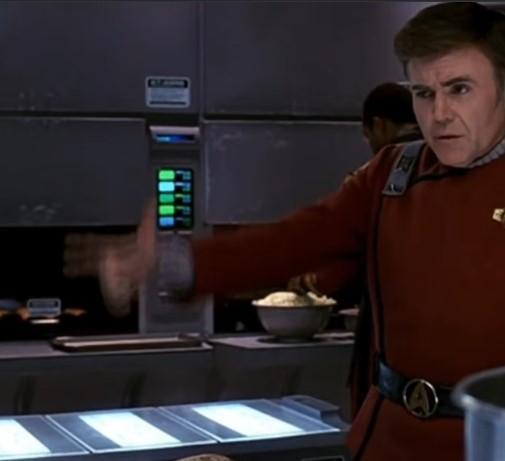
Did Star Trek become a parody of itself with First Contact? Not in my opinion. Like I have said before; that happened much earlier, With Spock’s brother, Uhura’s fan dance, Chekhov becoming a clueless ensign again after 30 years in the service, Kirk’s dialog with the shapeshifter, etcetera, etcetera, ad infinitum (don’t even get me started on that Polaris/Volarus/Valerian problem again) Becoming a parody of itself wasn’t the killing blow though. Not being entertaining was.
Since, as was pointed out in the counter opinion, this is about entertainment; and since I was not entertained by Nemesis and Enterprise; I’m understandably hesitant to trust Paramount to do anything right with Star Trek from now on. That will be the end of the franchise unless Paramount does the right thing with Star Trek XI. I’m not holding my breath on that one.