

I read this question nearly every day in the Meniere’s subreddit. Whoever it is has just asked doctor Google or talked to their life coach or whoever or whatever; and that resource said Meniere’s Disease to them and they are now freaking out about their potential chronic illness future. While looking around for more information on this mysterious illness they’ve just now learned about, they stumble across the Meniere’s subreddit. There are already dozens of recent posts there so they just add their new post to the pile. They describe their symptoms, which of course correspond in some rough way with Meniere’s symptoms (ear pressure, tinnitus, hearing loss and vertigo) and then they ask:
Do I have it? Do I have Meniere’s?
Why would you even ask the internet this question? Why would you believe the internet if it told you that’s what was wrong with you? Nevermind. I don’t care why. Everyone asks the internet about everything these days. I just wish that quack, Dr. Google, would stop telling everyone that they have a chronic illness.
If this is you, then this post is for you. I’m going to start with this disclaimer: I’m not a doctor. None of the people who respond on the subreddit are doctors; or at least, none of them admit they are doctors. Only a team of trained professionals are qualified to make the diagnosis you are asking about. No single doctor in their office all by themselves can tell if you have Meniere’s disease, and they certainly can’t do it based on a simple description of symptoms. Only a specialist in vestibular disorders, generally a sub-specialty of Otolaryngology, can effectively diagnose you.
It will take at least a dozen tests run at three or four different labs, and possibly that many months of time or more, to rule out all the known causes of the symptoms that are being described by the new sufferer and leave you with a Meniere’s diagnosis. I say leave you with because Meniere’s Disease is idiopathic endolymphatic hydrops, a fluid imbalance of the inner ear that has no known cause. You don’t want that diagnosis. You want a diagnosis for something with known causes and scientifically proven treatments.
Some time ago I answered one of these pleas from a person who had been casually told in passing that they might have Meniere’s and this sent them into a panic. The emergency medical technician who relayed this faux-diagnosis was working a shift at the emergency room that they went to after they had been experiencing vertigo for several hours. Dehydration had set in (projectile vomiting for hours will do that) and they and their loved ones were concerned about what might have caused this symptom to suddenly show up. They did the smart thing. They went to the emergency room and were treated with all the marvels that modern medicine can provide. They were also treated with the bad information that travels from mouth to mouth faster than the truth can put on its pants in the morning.
I asked the sufferer to private message me with their concerns and they almost immediately wrote me back. They were understandably concerned about these suddenly occurring symptoms that were ruining their life. One of the first things that I learned in these PM’s was that COVID figured into their history, as it has done for so many other people recently:
I also learned that they had a tooth infection and were going to get the tooth extracted soon. As soon as I heard that there was an upper tooth problem that they were dealing with I knew that what they were experiencing was probably not COVID-related Meniere’s symptoms. It was probably neuritis caused by the tooth infection. This was a classic triage situation.
Triage requires that you deal with the most pressing issues first. Tooth infections are far more serious than most people realize. In the not too distant past, tooth infection was a leading cause of death. While rare now, death can still occur due to an untreated tooth infection. The vertigo could easily be a symptom of the infection. They should treat the infection and then extract the tooth after that if necessary.
A few weeks of handholding later and their tooth had been pulled. As soon as the infected tooth had been removed from their jaw, they felt better. They were left with a gift of some low-tone tinnitus as a reminder to take dental hygiene seriously and are still dealing with the possibility of fluid buildup in the middle ear and other complications; but the vertigo and the unneeded treatments for Meniere’s have now been stopped. Their hearing has returned to normal, but they are still haunted by the possibility of a Meniere’s diagnosis in their future.
Meniere’s Disease is a very specific label that gets applied to a whole range of unrelated causes, as the story above should make clear. I go through a good portion of the tests and possible alternative explanations for Meniere’s-like symptoms in my treatment article:
So I’m not going to go through it all again here. Click that link, read that article. There are nearly a dozen tests. Nearly a dozen possible causes of the symptoms. Causes that aren’t the inexplicable Meniere’s Disease.
I’ll say it again now you really don’t want to know if you have Meniere’s disease. That’s the short answer to the question. Meniere’s is just the diagnosis you are left with when your diagnostic team has eliminated all the other options by testing for what might be destroying your vestibular system.
The question you should be asking is “is this an ear problem or a nerve problem?” If it’s an ear problem then you should ask about cochlear/endolymphatic hydrops and what might be causing that. You’ll need an otolaryngologist or ENT to answer those questions. If it’s a nerve problem then you want to talk to a neurologist. In either case you’ll probably start with a CT scan and an MRI, but that’s just SOP and, again, covered in the treatment article.
What these new sufferers want me to say is “you don’t have a chronic illness.” They want me to tell them that they won’t be suffering these symptoms for the rest of their lives. I’m tempted to flippantly say life is suffering in response, but that would be an untruth and an injustice. There is suffering and then there’s suffering.
I’ll take my kind of suffering over that of a cancer patient any day; and yet there is something truly crushing about the experience of vertigo, the constant hammering of tinnitus and ear pressure. Vincent Van Gogh probably cut his ear off because of ear pressure, vertigo and tinnitus. I’ve been tempted to dig out my ear with an ice pick many times. There’s no telling how many people have killed themselves because of the burden of carrying on while experiencing these symptoms, so it’s not something to be joked about even when I’m tempted to do so.
(The treatment I utilized to avoid digging my ear out with an icepick is discussed here)
Life goes on as long as you let it. Hopefully as long as it can with a decent quality of life, a quality determined by the experiencer and not by an independent panel of judges. Suffering is just a part of that life, a fact that I’m reminded of more and more frequently as I near the sixty year old mark. The lower back pain rivals the vestibular issues for primacy in these later years. Now, that’s suffering.
Strangling your anxiety in its sleep is probably the best gift you can give yourself when it comes to wondering if the symptoms you are experiencing are chronic or just episodic. Patience is what is needed most to get through this ordeal in front of you. I find great value in meditation and a dedication to distraction when required. That and good meds are essential.
The thing that might do the most good for the overall mental health of people worrying about whether they have Meniere’s or not is for the various resources out there to stop pushing Meniere’s as a diagnosis. It’s not a proper diagnosis. It is a syndrome, not a diseases. A cluster of symptoms with no known cause.
Cochlear hydrops (or endolymphatic hydrops) is a proper diagnosis. Cochlear hydrops affects a much larger portion of the population than the small group of people who will ultimately suffer hearing loss and battle with chronic vertigo, will be rendered incapable of working at any job in a predictable fashion and so have to go on disability. That is what Meniere’s means to the sufferers who first hear the name Meniere’s Disease when they go looking for what might be making them dizzy.
In Germany the doctors diagnose these symptoms as potential cochlear hydrops (hydrops cochleae) They only give the morbus Meniere’s diagnosis after some certain point in time and loss of hearing and balance that 75% of the sufferers never get to. You can have cochlear hydrops and get over it. You can’t have Meniere’s and get over it. If you do get over it, you never really had Meniere’s in the first place.
/r/Menieres (deleted post) r/Menieres (deleted post)
There will be thousands of people who, after reading that last paragraph, will immediately insist that their Meniere’s went into remission. Most of those people were probably misdiagnosed or had cochlear hydrops that didn’t progress into full Meniere’s (morbus Meniere’s as mentioned previously) In my estimation Meniere’s doesn’t so much go into remission as the sufferers learn to avoid triggers and once the triggering behavior is modified the symptoms disappear.
Half of those people will show up asking questions when subsequent changes in their behavioral patterns leads to stress and the consequent triggering of symptoms. They just need to make adjustments to the new patterns (including different treatments for symptoms) to make Meniere’s seem to stop. Again.
Until we determine an etiology for our individual diseases, it is safest to believe that the disease is still present and act accordingly. It is truly frustrating to constantly be prepared for the world to come unstuck and spiral around your head; but it’s been my experience that this will happen again and again, sometimes with years of separation between bouts.
Keep those vertigo treatments handy when embarking on a change in behavior. You will likely need them.
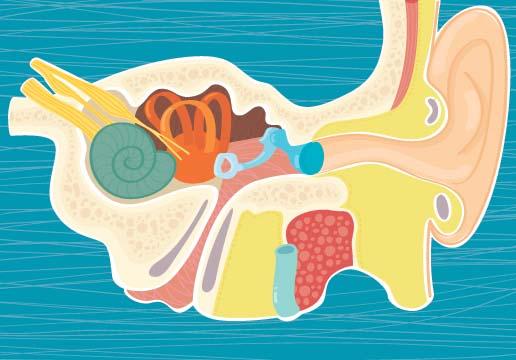
Featured image is medcomic.com’s Meniere’s illustration. Used with permission.
The Begging Block
Writing is work. A lot of work. Maintaining a blog takes a lot of time and energy. I don’t have ads on the blog because I fucking hate advertising and I never received anything worth mentioning from Google ads during the decade I let them place ads on my blog (ditto for the Amazon affiliate program, which is why those links are now slowly going away) This means that if I want to defray the costs of maintaining this blog, it has to come from my readers. If you are reading this and if you can afford to throw me a buck, I’m counting on you to click one of the links below and send me a few of them. The Wife, the children and I thank you. Especially the children, who have grown tired of cold gruel.