
Every now and then I hit on an episode of Decoder Ring that hits me back. This episode was one of those:
A History of Murphy’s Law by Nick T. Spark
Murphy might have been a person. As Nick Spark (and Craig Ryan, who wrote Sonic Wind, that book that inspired Spark) discovered, John Paul Stapp, a pioneer in the science of surviving crashes, was the evangelist that brought Murphy’s law to fame. It wasn’t, however, a truly original idea. As the podcast goes on to discuss, the law itself describes an engineer’s understanding of the responsibility of design.
There was a Murphy on the testing range and he stated a law, but it wasn’t the law they wrote down for him. The idea that they did write down and then promote predates all of them.
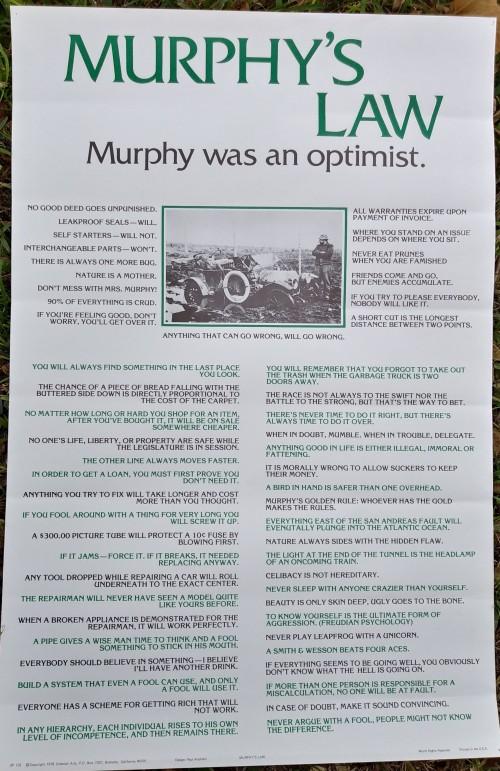
I still have the Murphy’s Law poster that hung in my bedroom for most of my teenage years. The featured image is a snapshot of it (Celestial Arts – 1979 – Designed by Paul Adreini) Yes, that poster actually hung on my wall right next to the poster of Christy Brinkley, near the Star Wars and Battlestar Galactica dioramas that hung from my ceiling. I was a weird child, I’m pretty sure I’ve mentioned this before.
Murphy was an optimist, as the poster itself notes. Having said that, it would be in keeping with Murphy’s law that trying to prove the origin of the law would inevitably end up down a blind alley somewhere. Having not planned to avoid this failure in advance, the failure occurs. Murphy remains a mystery and an ironclad law of the universe.
Hanlon’s Razor (a derivative of Occam’s Razor) was first published in book 2 of Murphy’s Law.