


In the beginning, shame knew no sex. First-century Roman writers used “pudendum” to mean the genitals of men, women and animals. But it was women to whom the shame stuck.
In 1543, the word made an appearance alongside an odd illustration in an anatomical atlas by Andreas Vesalius, a Flemish physician sometimes called the “father of modern anatomy.” The image, although labeled a human uterus, looks unmistakably like a penis, but with a tuft of curly pubic hair near the head, reflecting the idea that women were just men with imperfect, internal body parts. (Also, recall the dearth of female corpses.)
A century later, a Dutch anatomist named Regnier de Graaf highlighted the role of the clitoris in female sexuality. “If these parts of the pudendum had not been endowed with such an exquisite sensitivity to pleasure,” he wrote, “no woman would be willing to take upon herself the irksome nine-months-long business of gestation, the painful and often fatal process of expelling the fetus, and the worrisome and care-ridden task of raising children.”
In 1895, anatomy officially recognized a pudendal region in both men and women. But 60 years later, only the “pudendum femininum” — the female shame part — was still listed. It would later be simplified to “pudendum” and used as a slightly more formal synonym for vulva. Today, the word appears in almost every medical textbook, including recent editions of “Gray’s Anatomy,” “Williams Obstetrics,” and “Comprehensive Gynecology.”
There are other terms that reflect antiquated notions about women. The word hymen, which persists in nearly all medical textbooks, shares the same root as Hymen, the Greek god of marriage. Nymphae, a slightly older term for the labia minora, comes from the Latin word for bride or beautiful young maiden. Even the word vagina, which translates into sheath, scabbard or close covering, suggests that this organ’s primary function is to house a penis, which is not accurate or scientifically neutral.
After some grumbling, however, everyone agreed that “pudendum” had to go.
Shame is one factor that contributes to women, transgender men and nonbinary people with vulvas receiving worse or delayed care. A 2014 survey by British charity The Eve Appeal found that one-third of young women avoided going to the doctor for gynecological health issues, and 65 percent struggled to say the words vagina or vulva. That same year, American public health researchers found that up to half of those with vulva pain never raised their concerns with their doctor, at least partly because of stigma.
Taking the ‘Shame Part’ Out of Female Anatomy – By Rachel E. Gross – Sept. 21, 2021
The following quote sums up my entire range of thought on this subject:
There will always be people who will be antediluvian. What is the point of having any terminology group unless it’s willing to grasp nettles on occasion?
Bernard Moxham
Your Vagina Is Terrific (and Everyone Else’s Opinions Still Are Not)Dec. 21, 2018
Featured image from the NYTimes article.
Postscript
Pinterest is attempting to piss me off. They’ve taken to pulling down art pieces that they object to based on some indistinct definition of “adult content.” I find it laughable that they think that pulling down two or three art pieces off my Pinterest boards is going to stop the rampant selling of sex that is all over their service. Every time I log on Pinterest I am bombarded by dozens (if not hundreds) of nude or nearly nude images of young women.
The things I’ve chosen to save are not adult content anymore than a marble statue from ancient Rome is adult content. Here’s one they’ve pulled down:
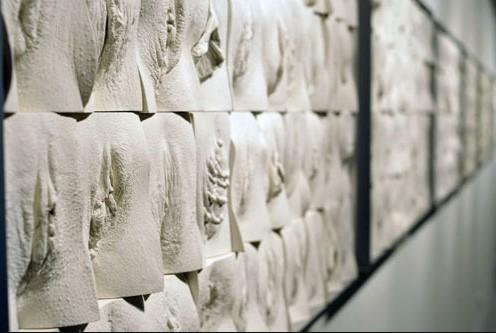
These rows upon rows of casts displayed in this way have nothing to do with eroticism. This was never about that. It is in fact not sexy at all. The brick-like grid of the uniformly white plaster casts becomes just texture from a distance. As you approach you realise what you are looking at. The geometry of 4 rows of 10 casts in each panel is repeated in the 10 panels, creating 4 lines of 100 casts. The solid aluminium frames in contrast to the undulating curves of the casts give it an almost architectural strength. That imposition of geometry on these simulacra of flesh and their sheer number and juxtaposition abstracts it away from any notion of pornography.
onesmallseed.com/Jamie McCartney
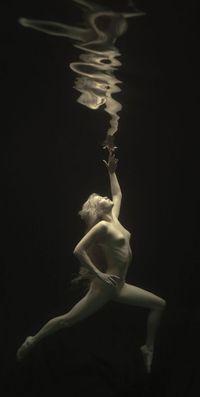
They’ve also pulled down some underwater photography that featured a naked woman (one of thousands I’ve seen on their service) that struck me as particularly artistic in it’s presentation (a beautiful reflection of her uplifted body and arm mirrored in the water’s surface) If you don’t want me sharing these images Pinterest, maybe you shouldn’t be showing them to me in the first place? Just a thought.
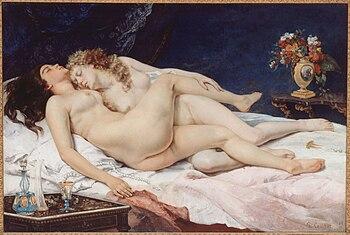
Classical artwork by Gustave Courbet (for example) is obviously not allowed unless you present it as a jigsaw puzzle that you can finger yourself while assembling. This is censorship, Pinterest. This is the Victorian ethic coming back to haunt us in 2025. There is nothing wrong with showing the human body nude. There is nothing wrong with being nude. What is wrong is attempting to squash the obsession with the human form in artwork; which a photograph essentially is, and makes Pinterest potentially the world’s largest art gallery. If only they didn’t allow their bots to get in the way of displaying real art.
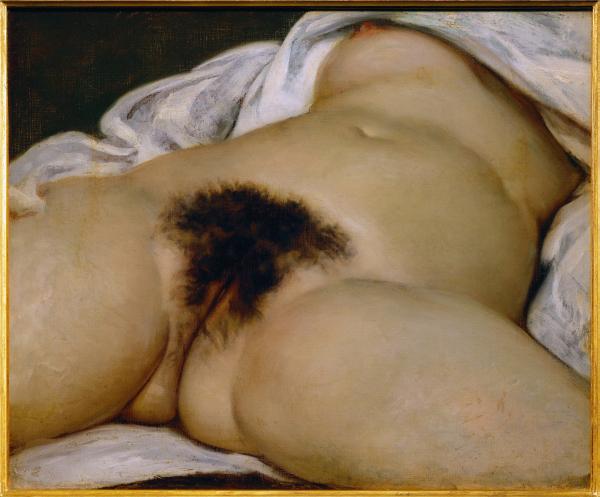
This complaint goes here because I feel like Kiss my Pudendum is the response that needs to be relayed to Pinterest on this subject. Stop pretending to care, Pinterest. It’s embarrassing.