

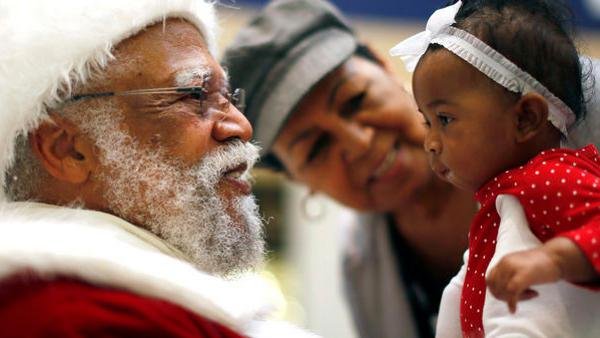
Atheists and skeptics generally step on the sense of wonder in their haste to squash pseudo-science, religiosity, false-piety and fear-mongering. I understand their goals and for the most part agree with them in principle even if I don’t agree with their often ham-handed tactics. Talk more, bludgeon less. I find that works best.
One of the subjects that they tend to stomp on mercilessly is the idea of Christmas as a christian holiday; and at the same time that they squash religion they also squash the figure of Santa Claus. Haven’t they heard that we need light-hearted things to celebrate this time of year? Think of the the poor SAD people, please!
I’ve lost count of the number of people who have specifically targeted Santa Claus in their personal lives, trumpeting raising children without fostering a belief in imaginary beings. I couldn’t disagree more with them. I need a reason to celebrate during these dark miserable months. If I have to make one up, then I’m going to do that.
I celebrate the secularized solstice holiday we refer to as Christmas in the US. It’s a non-religious holiday that involves a jolly fat guy who delivers presents dressed in a red suit. We spend the holiday with family and friends, giving gifts and trying to brighten the winter (Winter in central Texas is a frame of mind more than anything else; it certainly doesn’t have much to do with the weather) I also spend time reflecting on what the passing of this year means to me and preparing to celebrate the New Year.
The Wife and I discussed whether or not to share the myth of Santa Claus with our children before they were born. I wanted to burst that bubble; better yet, just not even go there in the first place, much like Penn Jillette discussed on his show. My memories of Santa Claus are generally unpleasant. I mean, Santa started off pretty good and then went South rather quickly as I got older.
Mother and Father did Christmas to the hilt in the beginning. Large tree, Santa decorations, pictures with Santa, the works. Once, when we were staying at our grandfather’s house in Sacramento, my sister and I heard a noise in the living room. We nearly made it to the door before our fear of being discovered and not getting any presents sent us scurrying back under our covers where we finally fell back to sleep. When we awoke the next morning, there were snow footprints on the fireplace hearth.
That was the best year. The next to worst year was the year when we were particularly nasty to Mom and Dad and got switches (sticks to get spankings with, for the uninitiated) in our stockings instead of candy. We bawled our eyes out that year.
Why is that the next to worst year? Because the worst year was the year when we found out that there was no Santa, and suddenly the magic was gone from the Holiday. Santa never came to our house again.
Not too long after that, there was the divorce and the hardship of an all too real nature as the family was torn apart, and there was no more talk of silly little things like Santa Claus. So you can imagine the mindset that I carried with me to the discussion.
For her part, The Wife never experienced an end to the myth. Even after she knew there was no physical person named Santa Claus that visited her house on Christmas eve, the presents from Santa still showed up. The stockings still were filled, even for Mom and Dad. It wasn’t until I met and married her that there was any magic during the holidays for me, and then only because of her.
She presented an argument that I couldn’t defeat. That there was something good in nurturing a sense of wonder in the children. That perhaps Santa isn’t a person, but is instead the charitable spirit that lives inside all of us. That the giving (and receiving) doesn’t have to end at all. Doesn’t have to be limited to just Christmas Day. It can be all-year ’round.
She had figured out how to tell our children that Santa Claus comes to our house without lying to them. Without verbally buying into the pageantry that surrounds the Santa Claus myth. Let them watch the shows, buy into the lore, do the whole thing if they want. If they ask us “is Santa real?” We have a simple non-committal answer to give them. The answer itself is a clue to the puzzle, but they have to want to solve the puzzle in order to find the truth.
Santa Claus is the Spirit of Giving, the anonymous benefactor who gives out of the kindness of his heart and doesn’t seek to be recognized for his charity. He leaves presents that are from no one, and fills stockings for the people sleeping under our roof, no matter the age. His is a kindly old soul that doesn’t get recognized enough these days.
The Daughter figured out that spirit meant just that, a giving feeling that comes from within, a few years ago. I know that she has figured it out because gifts appear under the tree or in the stockings that The Wife and I have never seen before. Santa Claus lives on in my house.

Oh, you can point to the Wiki entry on Santa Claus, and tell me how he’s actually St. Nicholas, and how his gifts were given personally. That he was a real person and he is really, very dead now. Or you can say that he’s the mythological figure, Father Christmas, and that as a mythological figure he never existed at all. It’s all fine by me, I love a good story. Red Ranger Came Calling is an excellent story about Santa Claus, and it’s just about as true as any of the rest of the stories are, including the Wiki page on St. Nicholas.
You just go right on believing whatever suits you. I know Santa will visit this house on Christmas Eve, no matter what anybody else believes.
Willful ignorance? If you like you can call it that. I can’t and won’t argue with you. I see it as a game, the same game it has always been. It’s a game shared by adults and children down through the years whether they knew it was a game or not. It can be a fun game or a hurtful game, but it is a game; and as an inveterate gamer myself, it’s one I’ve come to enjoy now that I understand it. It can be a valuable teaching tool when used correctly, and a crushing burden when used incorrectly. So play it wisely, always with the knowledge that a game should be fun. Otherwise, why play?
(archive.org) Featured image: http://richmondfreepress.com/news/2014/dec/05/santa-soul-black-history-museum/