
I recently sat down and watched Better Call Saul & Breaking Bad all the way through a second time, largely because my memory of the show the first time I watched it was so wrong:
Having now see all of it at least twice (some of it three or four times, even) I feel like I can explain what it is that I find interesting about the show. However, that explanation is going to contain lots of spoilers. Stop reading now if you don’t want spoilers.
¡Spoiler Alert!
Let me start by just saying that the series Breaking Bad is one of the most aptly named series in the history of television. Walter White self destructs in ways that are quite hard to understand, by the end of the series. Was he always that evil? Where did it all go wrong?
Clearly, he starts off caring about other people. He backs out of the company he helped found, Grey Matter, asking for nothing, when it becomes clear that he’s the loser in a love triangle. He takes a job teaching science to high school students; and he’s a good teacher with a clear love for chemistry. He starts a family with a woman who loves him and they have two children together. They are, in fact, a completely typical American family.
Then the cancer appears. With the cancer the first cracks in his character also appear. He becomes resentful of his former lovers/business partners. Their health and success galls him. He no longer cares about the kids he used to teach, going so far as to drag one of them (Jesse Pinkman) into the life of crime that he plans on using to pay for his cancer treatments. He gets his former students to sell his drugs to other students, drugs that will ruin their lives in ways not much different than the way his life is now ruined.
He can’t see what this plan of his does to his moral character, that much is obvious. This is the first sign that perhaps the Walter White we think we know isn’t the real Walter White. At the very least he has tunnel vision, and the tunnel gets narrower and darker with each season as he crosses one boundary after another that he never would have crossed had he not been forced to deal with his cancer.
The point of no return is reached at the end of season two when he watches Jane die instead of saving her. Up to that point he hasn’t done anything that he couldn’t walk back from as a human being. He’s broken, but he’s fixable. The event is so apocalyptic that the entire season is framed within the vision of the plane crash accidentally caused by Jane’s father (excellently played by John de Lancie) when he returns to work as an air traffic controller.
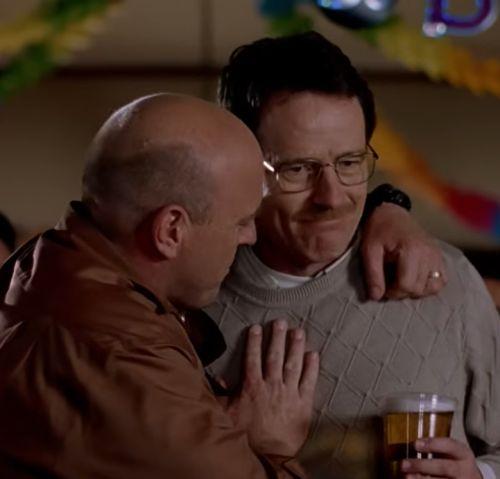
There are virtually no good people in the show. None of them that don’t end up dead. Nearly every major character is flawed in some deep way. They all seem normal on the surface, but the moment you get to know them, the flaws reveal themselves. The casual misogyny and racism of Hank the DEA agent. Marie’s kleptomania. Skylar‘s inability to see who her husband really is.
This is why Jesse Pinkman ends up being the everyman for the show, the character that the viewer ends up identifying with. As flawed as he is, he is ultimately blameless for virtually everything that happens. Accidentally releasing him from his slavery and imprisonment is the act that ultimately redeems Walter White. His goal achieved, his legendary blue meth formula now his again, he dies admiring the drug empire that he has reclaimed for himself. He may be evil, but at least he wasn’t (watched Jane die!) completely heartless.
If you want heroes, watch some other show. The reason to watch Breaking Bad is to savor the delicious evil that are the main characters of the show. Giancarlo Esposito’s Gustavo Fring is so much fun to watch that I make a point to try to catch everything else he has done. He is an amazing actor. I waited on tenter hooks for him to show up in the prequal series.
Speaking of Better Call Saul, Bob Odenkirk’s Saul Goodman reminds me of no one so much as that real estate developer the Republicans seem to think of as the second coming of christ (He’s just the latest in a long line of antichrists that started with Saul of Tarsus. What’s in a name? -ed.) I definitely enjoyed Better Call Saul more during the brief four years that Little Donnie was throwing his tantrums outside of the White House rather than in it.
LegalEagle: Real Lawyer Reacts to Better Call Saul (Episode 1)
Luckily, Better Call Saul really isn’t about Saul Goodman. The show is about how a small-time conman stumbles into a drug-fueled gang war that he can’t extract himself from because he’s blinded by the lure of easy money. Rhea Seehorn’s Kim Wexler tries to point out to Jimmy (Saul’s alter ego) several times, that he’s a lawyer. It’s not hard to make money with a law degree and a license. A law license is essentially a license to print money. Ask almost any congressman.
Jimmy can’t see it. What he sees is his brother’s disapproval. He sees his father’s naivete, allowing himself to be taken advantage of by the customers in his store. He starts running cons because he doesn’t want to be a mark like his father (Wolves & Sheep) He tries following in his brother’s footsteps (Michael McKean’s Chuck McGill) after his brother rescues him from his dead-end life running cons in their hometown (Chicago Sunroof) however, Chuck will never see him as anything other than a conman, and in the end it seems like Chuck understood Jimmy better than anyone else. You decide if that was a self-fulfilling prophecy or not.
LegalEagle: Real Lawyer Reacts to Better Call Saul (The Battery Episode, Chicanery)
The entire premise of Better Call Saul is based on a single line of dialog from Season 2, Episode 8 of Breaking Bad. Who was Ignacio? Who was Lalo? Twice as many television hours as the original series later, now we know.
The thing that makes Better Call Saul worth watching (aside from Giancarlo Esposito and Jonathan Banks, not to mention finally getting to meet Michael Mando’s Nacho Varga) is the character arc for Kim Wexler and Jimmy McGill that spans both shows. Whether you find the series finale gratifying is largely going to hinge on whether you believe that the conman would or wouldn’t take the deal he arranged for himself after finally being caught.
Are people able to grow and change or are they always trapped within their own limitations? Does love conquer all? Did Jimmy have to win against Kim in the sacrifice department?
Maybe Jimmy was more than a conman. Maybe Kim was actually good for him. In any case, I’ll be following Rhea Seahorn like I follow Giancarlo Esposito now. (Check out Pluribus on Apple TV if you get a chance. –ed.)
In this watch through I saved El Camino for last. There are several points in that movie that are just over the top (the quick draw gunfight, for example) but I wanted to end the viewing session with Jesse escaping into the wilds of Alaska. See him remembering his time with Mike and Jane, some of the better moments in the original series. It was a nice bookend for the roller coaster marathon that I had just been on.
I once owned a GM version of the El Camino that Jesse escapes in. It’s also true that “el camino” translates to “the way.” Jesse has found his way to heal. Someone ought to get something out of that tragedy.